
Why ITIL Plays a Critical Role in Strengthening IT Asset Management

1. Introduction
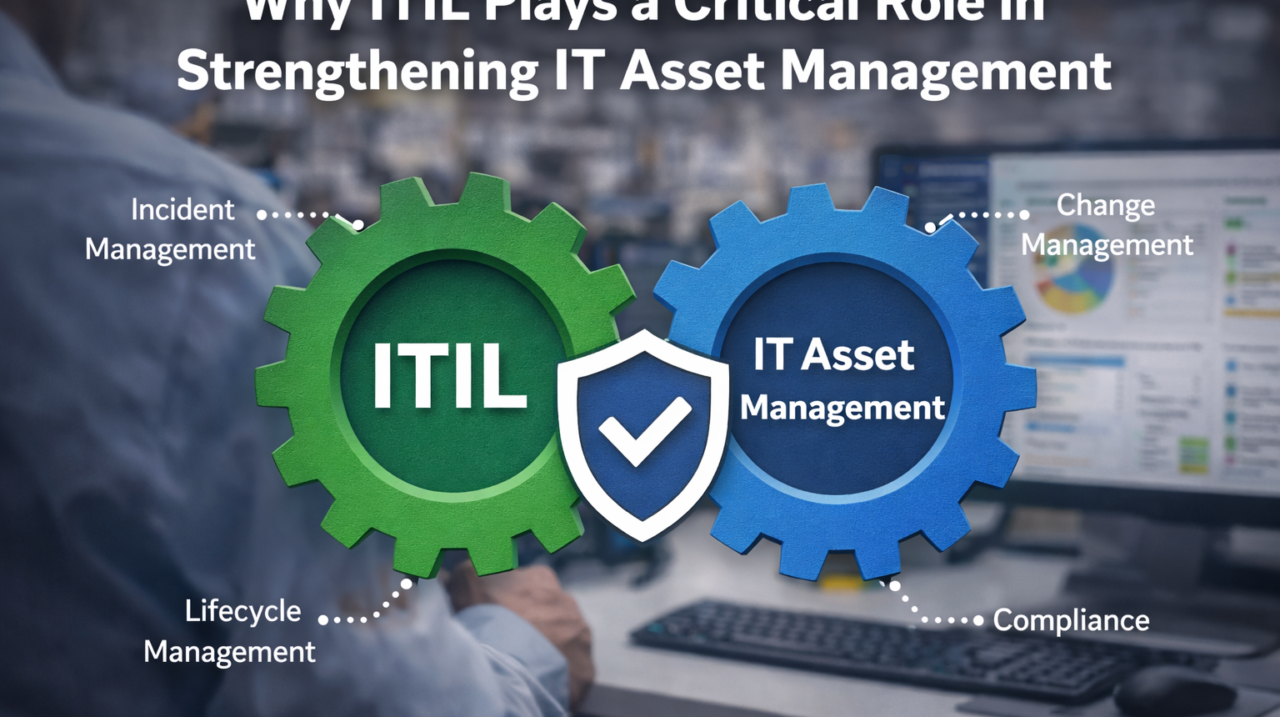
IT Asset Management (ITAM) is more than just tracking laptops, servers, and licenses—it is a structured discipline that helps organizations control cost, reduce risk, and optimize asset value. ITIL, on the other hand, is the global framework for IT service management. When combined, ITIL and ITAM create a powerful operational model that improves governance, service quality, and decision-making across the entire IT environment. This is precisely why ITIL plays a critical role in strengthening IT asset management. Indeed, understanding why ITIL plays a critical role in strengthening IT asset management is essential for maximizing service quality.
2. What ITIL Brings to ITAM
ITIL provides standardized best practices for managing IT services. These practices directly enhance ITAM operations by offering structure, governance, and process alignment. ITIL’s role in strengthening IT asset management cannot be overstated.
Key ITIL elements that support ITAM include:
- Service lifecycle structure
- Defined roles and responsibilities
- Change management controls
- Continual improvement practices
- Standardized data models
This ensures that ITAM is not just a tracking tool but an integrated part of IT operations.
3. Stronger Governance & Accountability
One of ITIL’s strengths is defining ownership and clear responsibilities. In many companies, asset records are inaccurate because ownership is unclear. ITIL solutions contribute significantly to strengthening IT asset management, reducing asset loss and unauthorized purchases.
ITIL solves this by enforcing:
- Assigned asset owners
- Role-based responsibilities
- Approval workflows
- Policy-driven actions
This reduces asset loss, unauthorized purchases, and unmanaged software installations.
4. Better Accuracy Through Process Integration
ITIL processes such as Incident Management, Change Management, and Configuration Management Database (CMDB) alignment create accurate, real-time visibility of assets. ITIL’s role in IT asset management is critical, ensuring configuration details remain consistent. Therefore, understanding why ITIL plays a critical role in strengthening IT asset management is vital for any IT department seeking to enhance its capabilities.
Examples:
- Every change request updates asset records
- Every incident is linked to affected assets
- The CMDB ensures configuration details remain consistent
This integration removes data gaps and ensures asset records are always reliable.
5. Enhanced Security & Compliance
ITAM alone cannot guarantee security or compliance unless it is linked to ITIL processes. Why does ITIL play a critical part in strengthening IT asset management? It provides standardized change approvals and policy-driven software usage.
ITIL improves ITAM compliance by providing:
- Standardized change approvals
- Controlled deployment processes
- Audit-ready documentation
- Policy-driven software usage
- Configuration baselines for devices
This lowers the risk of shadow IT, unlicensed software, and non-compliant hardware deployments.
6. Cost Optimization Through Service-Based Asset Planning
ITIL helps organizations understand why an asset exists by linking it to business services, reinforcing the asset management role ITIL plays.
This leads to:
- Eliminating unused or over-provisioned assets
- Smarter budget planning
- Better vendor negotiations
- Understanding true cost of IT services
By evaluating assets in the context of services, companies avoid unnecessary spending.
7. Improved Lifecycle Management
ITIL and ITAM together provide a structured lifecycle from procurement to disposal. ITIL strengthens IT asset management lifecycle by ensuring that at each stage there are defined processes, balancing service continuity with compliance.
Understanding why ITIL plays a critical role in strengthening IT asset management is crucial for effective lifecycle management in IT departments. ITIL ensures that at each stage—planning, deployment, maintenance, upgrade, retirement—there are defined processes. This ensures:
- Assets are procured through controlled requests
- Devices are deployed through standardized configurations
- Maintenance aligns with service continuity
- Disposal processes meet compliance and security requirements
This reduces downtime and extends asset lifespan.
8. Continual Improvement Culture
ITIL’s Continual Improvement Model encourages organizations to regularly review asset usage, cost, risk, and performance. By doing so, ITIL strengthens IT asset management by maintaining proactive functions.
This leads to:
- Updated asset standards
- Stronger refresh cycles
- Reduced waste
- Improved ROI on IT investments
ITAM becomes a proactive function rather than a reactive record-keeping activity.
9. Conclusion
Understanding why ITIL plays a critical role in strengthening IT asset management helps in combining its principles with ITAM for enhanced results. ITIL strengthens IT Asset Management by providing structure, governance, accurate data, lifecycle accountability, and service alignment. When ITAM follows ITIL principles, organizations gain better visibility, improved cost control, stronger compliance, and a more predictable IT environment. Combining both frameworks is essential for modern IT operations that demand transparency and efficiency.


 Feb 13, 2026
